So You Bought an LMTV: What to Fix Before You Drive It Home
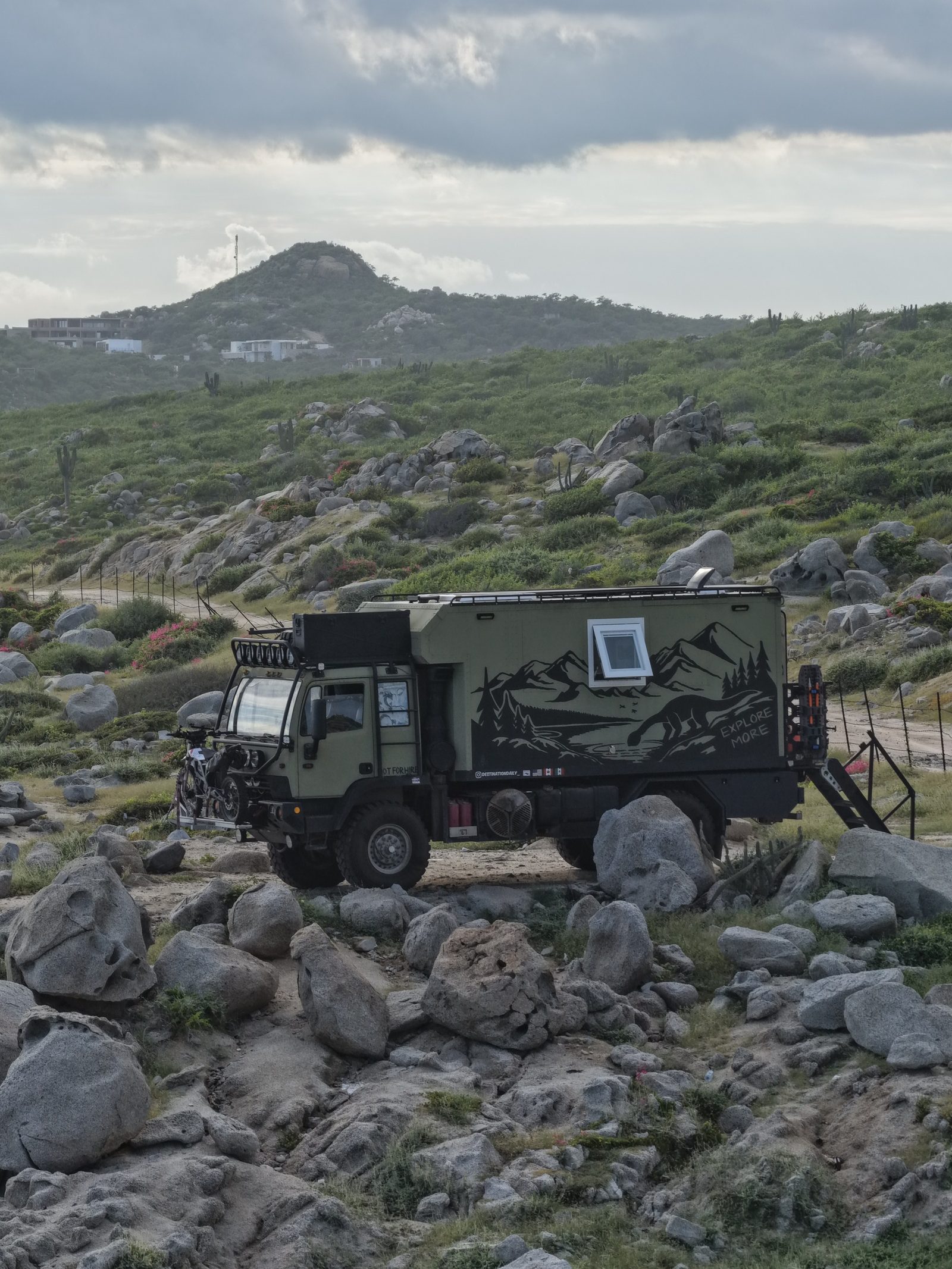
So you just bought an LMTV and you want to turn it into an expedition vehicle. Here is everything I would tell you, after two of these trucks and almost 40,000 miles behind the wheel.
The three models
The LMTV comes in three generations:
- A0: the first trucks, from the mid-1990s.
- A1: the late-1990s update.
- A1R: the mid-2000s trucks.
If I were to rebuild my truck, I would go with an A1R. It comes with the Caterpillar C7, a newer engine that is still well supported, and the jump of roughly 100 horsepower and almost 300 lb-ft of torque over the A0 is a fantastic addition.
Some variants also have top-mounted axles or drive shafts, which fix the truck's vibration issue. But all of them make a very good base and chassis for an expedition truck.
Every LMTV is rated for 100% off-road use. The 25,000 lb rating is for full off-road duty, so you can easily put on more weight and it handles it pretty darn well. That makes it the best base I know for a long-term luxury expedition truck, starting at a very cheap price for just the chassis.
What they cost
The cheapest I have seen someone get a mediocre truck for is about $7,000. Mine was $35,000. My specific truck already had a lot of fabrication done: the box was extended, a pass-through was built in, the rear ladder was designed, and there were plenty of holes cut in the side. For the money, the LMTV is absolutely amazing.
Before you drive it home
These are the things I always recommend doing on an A0 before you drive it home.
Fix the oil line of death. Do a quick search for it. You will find which part it is and the newer replacement versions straight away.
Fit EcoHubs or FastAxles. Anything that stops the truck screaming on the highway. These trucks vibrate a lot, and at full throttle it is common to crack the front timing cover. That is a job nobody wants to do. It is a pain.
Replace the seats. The factory seats are incredibly uncomfortable. On a 1,000-mile drive home, they will break your back.
Both of my trucks came from Texas, about 50 miles apart, and I drove both home to California to test them and make sure everything was fine. On the second truck I did everything above first, and the drive home was superb.
Air conditioning
Almost none of these trucks came with air conditioning, and the factory units are getting much harder to find. If you cannot find an OEM unit, Chinese suppliers sell rooftop units made for the back of semi trucks. I have seen plenty of people mount one on the roof or the back of the truck and say it cools it down perfectly. It is a very good option if you live somewhere hot or plan to live in the truck full time.
Power
The anemic factory alternator cannot really support DC-to-DC charging for a habitat. A 260-amp or 400-amp alternator is an incredible upgrade. I charge at about 3,000 watts while driving, and the alternator is still not being overworked.
These are 24-volt trucks, not 12-volt, and I always recommend building your habitat system in 24 V or 48 V. You can always step up or step down, but the higher the voltage, the thinner the cable you need and the more efficient the system is.
Grease, grease, grease
Those zerk fittings get pretty dry, and you do not want anything to break. In a hot climate, I grease every 1,500 to 2,000 miles. In a mild climate like Southern California or San Diego, 3,000 to 4,000 miles should be fine. But the more often you do it, the better.
The transmission and fuel economy
The Allison transmissions learn as you drive. If you switch to EcoHubs or FastAxles, the shifting gets so much better and the power range becomes far more usable.
The first time I drove mine after the change, oh my goodness, it felt like a brand-new truck. I was getting a little over 10 miles to the gallon with an empty habitat, which made the whole thing viable. Without those changes, expect about 6 miles to the gallon. It will eat fuel like crazy.
Tires
Look at the date code on the side of your tires. This is a big one. On day one of owning my first truck, I blew out the driver's front tire at 10 pm, at highway speed, in a little snow. It was awful. I was not prepared to change it on my first day, and I had no idea how tightly those front lugs are torqued. I was running on 20-year-old tires. No wonder. They become so brittle.
The Goodyears are the worst tires you can buy for these trucks. I know they are extremely popular. I have been through three sets, and the sidewalls are thin. I would never buy another set, no matter how cheap someone offered them.
Go for Michelin XZLs (not the XMLs) or Pirellis. I run the Pirellis. I think they are a better-looking tire, they have the same weight rating as the Michelins, and they do much better at highway speed than the Michelins a friend runs on his Unimog.
Locks
The military does not issue keys for these vehicles, so you get a truck you cannot lock. TriMark makes a fantastic lock, and plenty of people on YouTube have fitted them. I did too, and it fixed a lot of my everyday gripes with the truck.
Engine oil in the transmission
These trucks come with engine oil in the transmission instead of ATF. This is one thing I have not changed. I have never had a transmission issue, and I know quite a few people who got fault codes or problems after switching. I am going to wait on this one, and leave it up to you for your own truck.
Central tire inflation
The central tire inflation system is the part so many owners struggle with. Spend the time, go through the Steel Soldiers forums, and get yours dialed in. You will be so happy once you understand the system. When it is time to go off-road, you press a button and it deflates. It is probably one of my favorite things about these vehicles.
I do not know many people in the States with as much seat time in an LMTV as I have at this point. All of this comes from experience.
The community, and the catch
The community is incredible. The Facebook groups, the veterans and Steel Soldiers hold a wealth of information that makes these trucks fairly easy to own.
The catch: you must be mechanically inclined. In the United States, I did not find many shops that wanted to work on them. Here in Mexico, every heavy-duty diesel mechanic I have met has not cared. They tell me, "If you can get me directions on how to assemble something, I will 100% work on that part." It depends on where you are.
Parts can be difficult, especially the military-specific ones, and it seems that everything that breaks is a military-specific part. Keep that in mind when you decide where you want to travel and what spares you want to carry.
Would I do it again?
The M1079 comes with an insulated 12-foot box on the back. For the value, there is not much else with that much standing height, built that well, to turn into an expedition truck.
Would I do it again? 100%. If I did, I would probably get an A1R 6x6 and put a box on it. With the amount of off-roading I do, the 6x6 carries more weight with fewer issues. The 4x4 is incredible for turning radius, and that is my only drawback either way. My truck has a frame extension of about 3 feet, so it is already about the length of a 6x6.
That is just about everything I would recommend for these trucks. If you are still deciding on a base, start with how to choose an expedition vehicle.
 Read nextWater Systems for a DIY RV: Piping, Filtration and Capacity3 min read
The short version goes up on Instagram and TikTok first. A new post lands here on Fridays.
