
Expedition Truck Power Systems: Solar, Batteries and What I'd Change
Power is one of the most important systems on an expedition truck. There are a few routes you can take. You can lean on solar with a smaller battery, or on a large battery bank backed by solar and a generator. The right answer depends on how you use power, where you travel and how much space you have.
My system at a glance
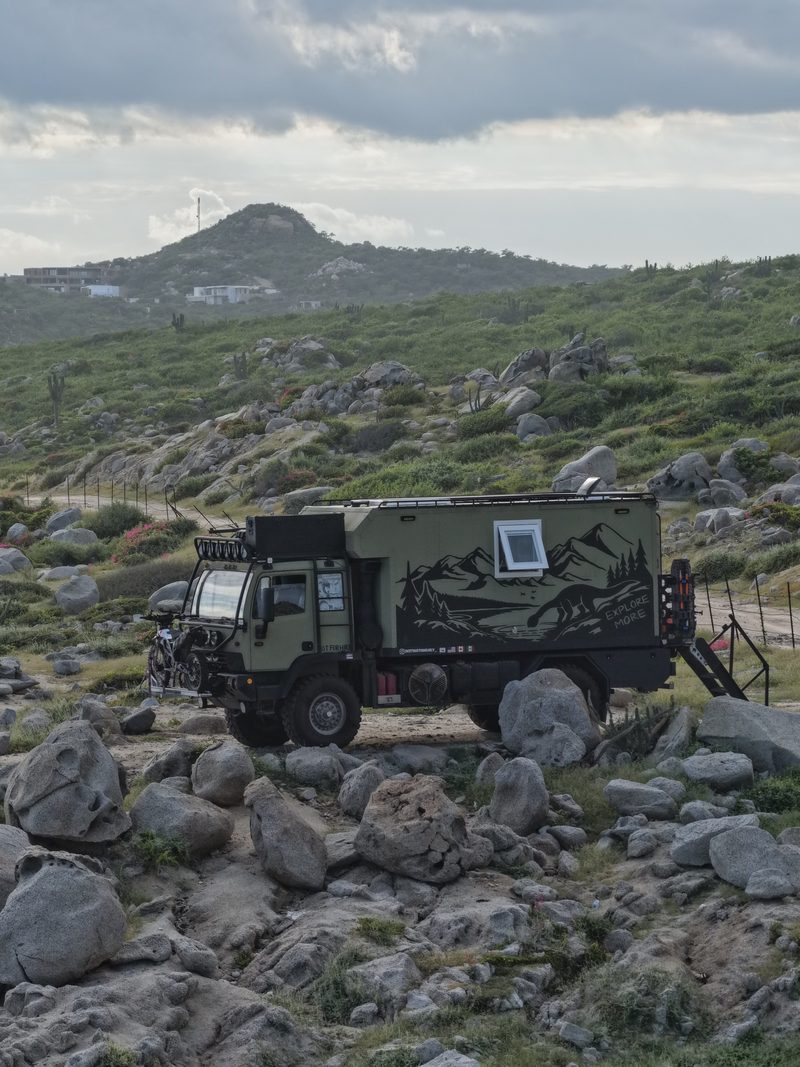
My truck is 26 feet long with a 15-foot habitat.
- Solar: 820 W, through one large MPPT charge controller.
- Battery: 14 kWh of lithium iron phosphate, in a single 48 V battery.
- Generator: a 14 kW diesel generator.
- Alternator charging: a 260 A alternator, giving me about 3,000 W while driving.
- Inverter: a Victron Quattro 48/5000.
- Monitoring: a shunt on the battery, and a Victron Cerbo GX sending everything to my phone.
- Switching: a Garmin Vieo digital switching system, controlled from a touchscreen or an app.
How long it lasts
Because of the choices I made, my truck draws a lot just sitting. My big fridge needs the inverter on all the time, and the cab's power also runs off the habitat battery. Parked here in Mexico, the battery lasts about 6 days. When it is cooler and the fridge runs much less, I get about 14 or 15 days before I need to run the generator or start the truck.
Solar: more than you think
I am a big believer in putting as much solar on your vehicle as possible. I wish I had gone to about 1,200 W. That would have been the perfect amount, and I would run the generator far less, especially when I am inside the truck.
Battery chemistry
There are two real options: lead acid and lithium iron phosphate (LiFePO4). I would never use lead acid. Zero percent of me would choose it. I would only ever go with lithium iron phosphate.
For research, Will Prowse's YouTube channel is my favorite source on batteries. Watch his videos before you buy anything.
For value, LiTime makes good-quality batteries at a great price. My battery is a BigBattery Rhino, a single 48 V, 14 kWh unit. To be honest, I probably would not use it again. I have had problems with it from day one.
How much battery
If you are going to live in your truck full time and you have the budget, I would start at 12 kWh of storage. If I did it again, I would go to around 20 kWh. That would give me much longer if I am away from the truck or parked somewhere I do not want to run the generator.
Which voltage
It depends on your vehicle. If your truck is a standard 12 V vehicle (alternator and starting battery), I would build the habitat in 12 V too, unless you want to step up to 24 V.
My LMTV is a 24 V truck, and I built a 48 V system. When I designed it, I planned to run 48 V DC air conditioning, so everything was built around that. In the end I switched to a standard 120 V AC unit. It is more efficient and a third of the price, so I went to 48 V for no reason.
The one real advantage of a higher voltage is thinner cable, so you save a little on wiring. But 48 V components are always more expensive than 12 or 24 V, and 12 V is by far the most common.
Charging while you drive
DC-to-DC charging is an absolute game changer if you move around a lot. With my 260 A alternator I get about 3,000 W of charging, and I would not change anything about it.
On a ProMaster or a smaller van, it is far more efficient to add a second alternator that only charges the habitat battery. Wakespeed makes high-output charging regulators for exactly that.
Victron's DC-to-DC chargers are so slow that I would never use one. But for everything else, Victron is incredible. It works out of the box and it is seamless. My Quattro has nothing I do not like about it, and with the Cerbo GX, checking and changing everything from my phone is a breeze.
Switching and control
The most unusual part of my system is the switching. Almost everything runs through the Garmin Vieo, so my electronics turn on through a touchscreen or an app. Apart from the water heater, there are no manual switches in the truck. I love it, but it is a lot more complicated.
Plenty of people build their own control panel on Home Assistant, and with AI tools like Claude it is now fairly simple to program your own if you are somewhat technically inclined. It is a mixed bag which is best. My favorite setup I have ever seen was a Home Assistant panel a friend built in his LMTV. I loved the interface, but it took him a long time.
Oversize your cables
This is the thing I recommend to everyone. I have seen too many vans burn down because the cables were not thick enough and everything heated up. This is where you want to spend your time, energy and money, especially if you travel somewhere hot. Run small cables and you are asking for trouble. Thicker cable costs a bit more, and it is well worth it.
Almost all of my small electronics run on 14 and 16 gauge wire. I know plenty of people who use 18 and 20 gauge. I would not. My heavy-duty runs are mostly 2 AWG, which is extremely thick, especially for the generator.
A few more safety basics that go with this:
- Fuse every positive cable, as close to the battery or power source as you can, and size the fuse to protect the wire.
- Fit a main battery disconnect, so you can kill everything in seconds.
- Use proper crimps and heat shrink, not twisted wires and tape, and support your cables so vibration cannot chafe through them. On a truck like this, everything shakes.
How to size your own system
Every six months to a year new gear comes out, so rather than copy my parts list, work out your own numbers and buy the most current gear for them. Here is the method I would use:
- List everything that uses power and how many hours a day it runs. The fridge, lights, fans, laptop, water pump and air conditioning are the usual suspects.
- Multiply watts by hours for each item and add them up. That is your daily use in watt-hours.
- Decide how many days you want to sit without driving or running a generator. Multiply your daily use by that number. That is roughly the battery you need.
- Fit as much solar as your roof allows. You will almost always wish you had more.
- Add alternator charging if you move often, and a generator if you plan to park for long stretches somewhere hot.
There are some incredible people on YouTube covering RV electrical systems. Go down the rabbit hole and do as much research as you can before you buy anything.
If you are just starting your build, read what to fix first on a new LMTV and how I built the water system.
 Read nextSo You Bought an LMTV: What to Fix Before You Drive It Home6 min read
The short version goes up on Instagram and TikTok first. A new post lands here on Fridays.
